
LogoDirect2App
icon of Kula - AI-Native ATS

Kula - AI-Native ATS

Kula is an AI-native applicant tracking system that unifies sourcing, screening, pipeline management, interviewing, and analytics to help teams hire up to 5× fā

Introduction

Kula – AI‑Native ATS Overview

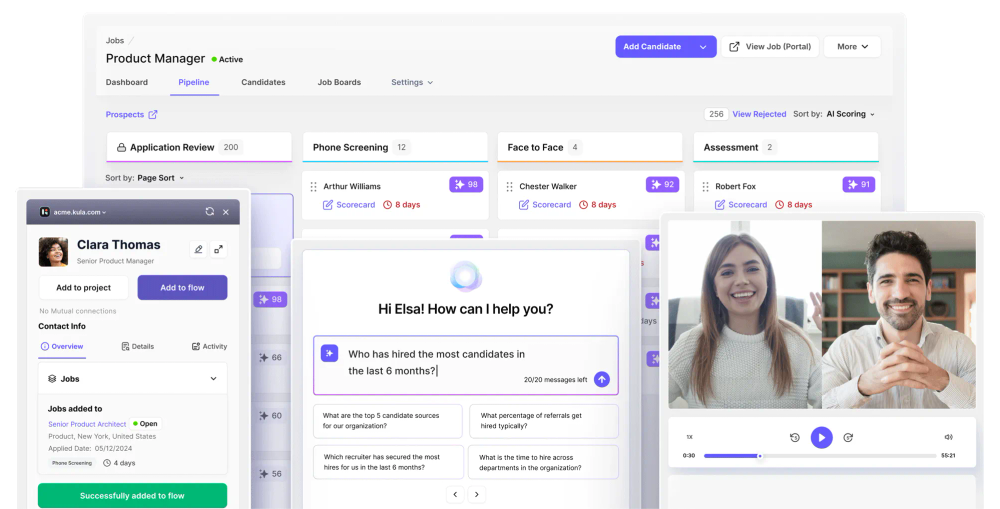
Kula is a full‑stack recruiting platform built for modern talent acquisition teams. It combines AI‑driven sourcing, advanced candidate scoring, automated interview scheduling, and built‑in analytics within a single, scalable interface. Key features include:

  • AI‑Native Workflow – Native AI models trained on real recruiter actions power every step, from sourcing to analytics.
  • Unified ATS – Sourcing & CRM, Applicant Tracking, Pipeline Management, AI Scheduling, AI Notetaker, and Conversational Analytics are all native modules, eliminating add‑ons and vendor sprawl.
  • AI Scoring & Ranking – Plain‑language candidate descriptions are parsed and scored, surfacing the best fits 2× faster.
  • Automated Outreach – Auto‑generate JDs, InMails, and drip campaigns with built‑in AI writing.
  • Interview Automation – AI Scheduler coordinates multi‑stage interviews across time zones; AI Notetaker transcribes and summarizes conversations.
  • Insights & Reporting – Conversational analytics let users ask hiring questions and receive visual, real‑time insights without BI tools.
  • Enterprise‑Grade Security – SOC 2 Type II, SSO, RBAC, GDPR/CCPA compliance, and bias‑free AI verified by Warden AI.
  • Cost Efficiency – Switching to Kula can reduce recruiting software spend by 30‑50% on average.

Typical Use Cases

  • Start‑ups and scaling teams needing a single system to replace multiple recruiting tools.
  • Enterprises seeking secure, compliant ATS with AI that reduces manual effort and bias.
  • Recruiters focused on speed‑to‑hire, quality‑of‑hire, and data‑driven decision‑making.
  • HR departments looking to cut costs while improving candidate experience.

Kula positions itself as the only truly AI‑native ATS that lets recruiters move faster without the bloat, compliance risk, or high fees of legacy systems.
Information

Categories

Newsletter

Join the Community

Subscribe to our newsletter for the latest news and updates